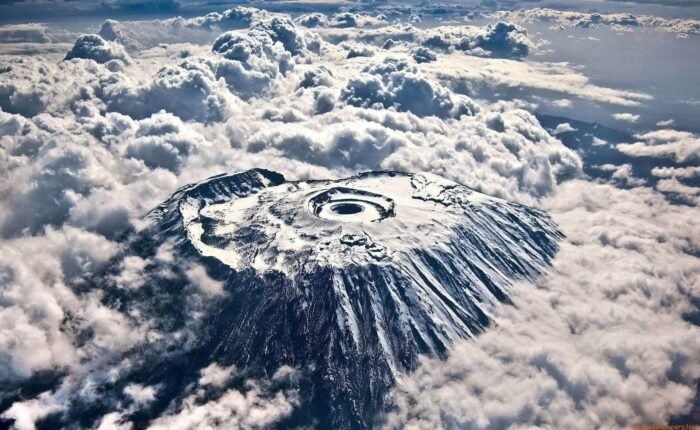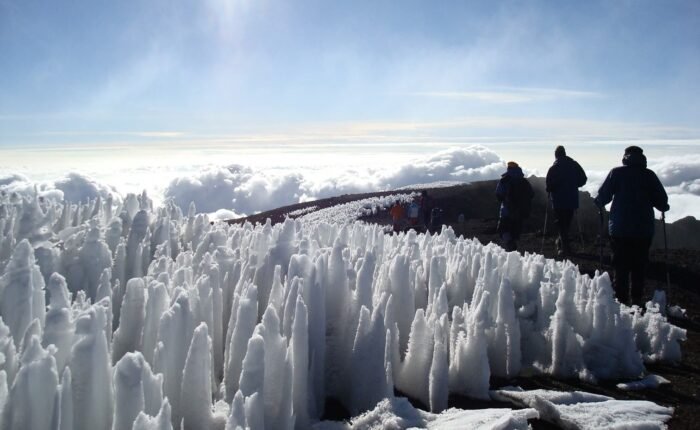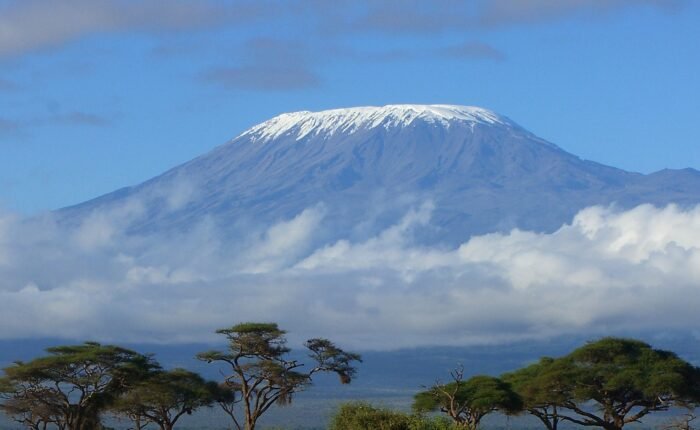
The Northern Circuit is the longest route on Kilimanjaro. It starts on the western side like Lemosho, then arcs around the quiet northern slopes before the summit push, so you walk almost the entire mountain. The slow pace gives you maximum time to acclimatise, and it is among the quietest routes, with few other trekkers.
Nine days on the mountain gives your body maximum time to adjust, and the northern side sees few other trekkers. This is the longest route, so it carries the highest park fees.
Day 0 (before the climb): Arrival in Moshi or Arusha. Airport pick-up, hotel transfer, and a gear check and briefing with your guide. Overnight: hotel.
Day 1 – Londorossi Gate to Mti Mkubwa Camp
Drive to the remote western gate, register, and walk through untouched rainforest, with colobus monkeys likely.
Day 2 – Mti Mkubwa to Shira 2 Camp
Cross the rainforest into the open Shira Plateau, with views of Kibo and Mount Meru.
Day 3 – Shira 2 Camp to Moir Hut
A quiet walk on the far northern side, well away from the main crowds.
Day 4 – Moir Hut to Buffalo Camp
Climb over Lent Group (4,630 m), then drop into the remote northern slopes.
Day 5 – Buffalo Camp to Third Cave
Traverse the northern slopes. Long views over the Kenyan border and open country.
Day 6 – Third Cave to School Hut
Cross the Saddle to the foot of the final summit approach. Early dinner and rest.
Day 7 – Summit day: School Hut to Uhuru Peak to Millennium Camp
Midnight start via Gilman’s Point to Uhuru Peak, then descend to Millennium Camp.
Day 8 – Millennium Camp to Mweka Camp
A gentle descent through the moorland and into the forest zone.
Day 9 – Mweka Camp to Mweka Gate
Final forest descent, summit certificates and a hot shower in Moshi.
After the climb: continue to your hotel for a hot shower and celebration dinner. Ask us about adding a safari or Zanzibar extension for your departure day.
| Tier | 1 | 2 | 3 | 4 | 5 | 6 | 7 | 8 | 9 | 10+ |
|---|---|---|---|---|---|---|---|---|---|---|
| Budget | 3,180 | 2,650 | 2,640 | 2,630 | 2,620 | 2,610 | 2,600 | 2,595 | 2,590 | 2,585 |
| Standard | 3,780 | 3,150 | 3,125 | 3,100 | 3,080 | 3,060 | 3,045 | 3,030 | 3,020 | 3,010 |
Prices are in US dollars per person and include 2026 park fees. Group prices apply when everyone books the same departure together. Park fees and government taxes are set by KINAPA/TANAPA and may change; the price is confirmed at payment.
Budget vs Standard: what’s the difference?
| Budget | Standard | |
|---|---|---|
| Accommodation | Quality shared tents and mattresses | Roomy waterproof tents and thick mattresses, with a private mess tent |
| Toilet | Shared camp toilet facilities | Private portable flush toilet tent |
| Crew | Licensed guide, assistant guide, cook, porters | Larger crew with extra porters and a dedicated waiter |
| Meals | 3 meals a day, tea and coffee | 3 meals a day plus snacks and a wider menu |
| Sleeping gear | Mattress and standard sleeping bag provided | Premium four-season sleeping bag and liner provided |
| Table, chairs | Dining tent with table and chairs | Private mess tent with table and chairs |
| Hotel in Moshi | 1 night before the climb (B&B) | 2 nights, before and after the climb (B&B) |
Both packages include licensed, English-speaking guides, emergency oxygen, a pulse oximeter, a first-aid kit and emergency evacuation support.
What’s included (both packages)
What’s not included
Park fee breakdown (per climber, 2026)
| Fee | Calculation | Amount |
|---|---|---|
| Conservation fee | US$70 × 9 days | US$630 |
| Camping fees | US$50 × 8 nights | US$400 |
| Rescue fee | one-off | US$20 |
| Subtotal | US$1,050 | |
| VAT (18%) | US$189.00 | |
| Total park fees | US$1,239.00 |
Guide and porter entrance fees are paid by us and included in the package.
You don’t need technical climbing skills, as it is a walk, not a climb. It is still a demanding multi-day trek at altitude, so good fitness and steady training in the months before help a lot. Difficulty on this itinerary is: Moderate (long but gradual).
Nine days means more park fees (US$1,239 per climber), more food, and more crew wages. In return, you get the most gradual acclimatisation and the quietest trails.
No. Many of our climbers are first-timers. We recommend regular hiking, cardio and leg strengthening for at least 8–12 weeks before your trip.
The best months are January–March, June–October, with clear skies and the most stable conditions. Kilimanjaro can be climbed all year, but April–May and November are the main rains.
Our guides are trained in altitude-sickness management and check your oxygen saturation and pulse twice a day. We follow the ‘climb high, sleep low’ principle, carry emergency oxygen and a first-aid kit, and arrange a safe descent if needed
Yes. Prices are per person, and the more people in your group, the lower the price per person (see the table above). Park fees, crew wages, meals, camping or hut fees and transfers are included.
Tipping is voluntary but expected, and it is a large part of the crew’s income. As a guide, budget about US$250–$400 per climber for a 6–7-day climb and US$300–$450 for 8–9 days, shared across the whole crew. We explain the process in your pre-climb briefing.
A 30% deposit confirms your booking and the balance is due before the trek starts. Free cancellation up to 30 days before departure; 50% refund between 30 and 15 days; no refund inside 15 days. We accept bank transfer, credit card or PayPal.